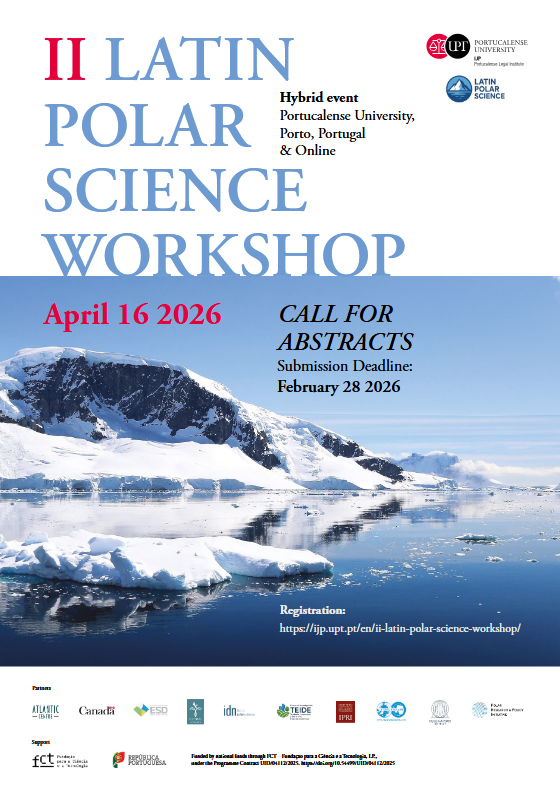

II Latin Polar Science Workshop
The polar regions—the Arctic and Antarctic—are essential to the stability of the Earth’s climate system, and the impacts of their rapid changes extend far beyond their geographic boundaries. These shifts influence global weather patterns, contribute to sea level rise, and affect ecosystems worldwide. Although geographically distant, Latin America and Southern Europe are significantly affected by these changes and play an increasingly important role in polar research, particularly through national Antarctic programs and emerging research groups. However, collaboration among Latin polar researchers remains limited, and early career scientists often lack structured opportunities for training, networking, and policy engagement.
The 2nd Latin Polar Science Workshop, organized by Latin Polar Science in partnership with the Portucalense Legal Institute (Portucalense University), aims to address these gaps by fostering a collaborative platform for scientists, students, policymakers, and educators from Latin America and Southern Europe. The event aims to strengthen regional research networks, support early career researchers through training and mentoring, promote interdisciplinary approaches linking polar processes to climate and ocean systems, and enhance the regions’ presence in global polar science discussions.
This interdisciplinary edition will take place on 16 April 2026 and will bring together experts, diplomats, and researchers from countries such as Portugal, Brazil, Spain, and Italy to discuss a broad range of topics, including polar infrastructures, climate impacts on the cryosphere, polar science diplomacy, Arctic governance, indigenous communities, marine life, climate–ocean connections, and other emerging theme.
A call for abstract submissions is open until 28 February – extended until 8 March.
Registration and further information: https://ijp.upt.pt/en/ii-latin-polar-science-workshop/
Please note: registration for participation as an attendee remains open regardless of the abstract submission deadline − until 22 March for on site participation and 10 April for online participation.